Dekalog 1, - Krystoff Kieslowski A young boy living alone with his father begins asking questions
concerning mortality and faith, through his wide and pale blue eyes we come to
share the same tender curiosity. It is this inquisitive innocence that becomes the
deceptively simple focus of the film’s human – and excruciatingly tragic –
drama. This is the first Kieslowski film I’ve seen, and it reminded my of the
later Dardenne brothers – evoking the same sincere portrayal of believably real
characters, in upsettingly real situations. However, this felt more poeticised
with its ability to invite a more abstract and metaphysical atmosphere –
lingering in close ups of expressions and intuitively using transitions of
focus and colour to suffuse its realism with an immersive language of mood.
Ghostly, profoundly observed and intensely, heart wrenchingly tragic. A film
that, if you claim to be in possession of any sort of pulse or breath, will
stay with you – repeating its melancholy images in an echoed memory that, mysteriously/mercilessly,
seem to get more significant and sorrowful with each recollection. 10/10 [ have also now watched 2 and 3 –
nether being quite as good as the first, but still very involving dramas]


Ghost Dance – Ken McMullen – A film in which artistic
and cerbral theorising engages in convoluted battle with a shoestring budget to
create a film that is often unintentionally (it would seem) hilarious,
pretentious, fascinating, admirable and equally, fairly god-awful. Taking the
notion of ‘ghosts’/ spectral haunting and memory as intimately linked with the
birth of recording technology as its intellectual raison d’etre, the film
focuses around the wandering antics of two women – one French and one English.
For a film of such evidently academic/arthouse aspirations its portrayal of the
two women is exuberantly insensitive. The French woman, named Pascal, is a
cartoon encapsualtion of the vulnerable artiste: simultaneously troubled and
enthralled by the introspection that motivates her vague journey for even more
vague understanding. Meanwhile, the English woman represents a grounded force
of logic, happy to chip in on the intellectual joy-ride, but essentialy there
to anchor Pascal. One example of this - less than nuanced - pairing of national
stereotypes, arises when Pascal stumbles in, still half asleep, to recall a
dream she has just had. After much non-specific pontification, Pascal pauses,
her expression wistfully lost in the mists of a half remembered dream. The
English woman takes this reprieve as a cue for her to contribute: ‘It’s
probably still damp in that room.’ With one swift aside of logical rumination,
Ms. English extinguishes the wisping philosophy of the dream world, banished
with her recklessly mundane observation. The French are dreamers, the English
moan about the damp. It is a somewhat stunted, if not consistently
entertaining, portrayal.

Then, just to really boost the curious
credentials of this endearingly ambitious oddball-of-a-film, Derrida has a
substantial cameo playing himself. Surely this overwrought soup of misguided
intellect and avant-garde musings could ask for no more than this, Derrida, the
enigmatic kingpin of all things insightfully complex…but no, there is more: a
young Robby Coltrane (of later Hagrid fame) plays an aspiring drummer, who
avidly accompanies radio broadcasts of the shipping news/and/or weather
forecast with shuffling jazz percussion – in the flat above the two women. So,
Robby Coltrane gleefully bashes his drum kit along to a small radio and Derrida
offers his wisdom, while an early Brian Eno-esque, synth soundtrack blares away
with sci-fi convictions. Naturally.


As an example of
the laughably high-minded intent of the film:
Derrida, in prime ‘European Thinker’ mode, is first seen
sipping from a coffee in a Parisian café and, for some reason (perhaps self
awareness), blinking profusely. He wrinkles his forehead, as if nonchalantly
engaged in minute to minute deconstruction, beneath his chin ruffles the
carmine flourish of a cravat, he stares into the near empty espresso: he is
alone. Our young french protagonist saunters in to join him; she looks pale and
visibly distressed. Her wide eyes communicate a soulful Bambi existentialism,
while her dishevelled demeanour and ethereal voice suggests the floating spirit
of a bohemia. She is a student. Suffering essay troubles and misunderstood by
the normative structures of the University’s conventional institution (it’s
tiresome ‘marks,’ and its lecturers, so professionally equipped to neglect the real questions), alas she feels alone
with her intellectual journey. Cue: Derrida, the fortuitous Yoda of real questions. And so:
‘What is the idea behind your idea?’
* Bambi considers*
‘The idea behind my idea is…
…That I have no idea’
*Profound
silence*

Yoda takes a
victory sip; the maverick deconstructor blows minds like this every day. Her
vulnerable heart flutters, newly aflame with inspiration – the Tutor has
spoken. Derrida’s later appearance involves a lengthy chat in which he
verbalises the crux of the film’s own essay. Once transcribed, it makes for an
effortless and genuine illustration of Derrida’s own questioning and fiercely
intelligent thought – which, unencumbered by the film, endure far better:

Question to Derrida: Do you believe in ghosts?
‘That’s a difficult question. Firstly, you’re asking a ghost
whether he believes in ghosts. Here, the ghost is me. Since I’ve been asked to
play myself…in a film which is more or less improvised…I feel as if I’m letting
a ghost speak for me. Curiously, instead of playing myself…without knowing it…I
let a ghost ventriloquize my words, or play my role…which is even more amusing.
The cinema is the art of ghosts, a battle of phantoms. That’s what I think the
cinema is about, when it’s not boring. It’s the art of allowing ghosts to come
back. That’s what we’re doing now. Therefore, if I am a ghost, but believe I’m
speaking with my own voice…it’s precisely because I believe it’s my own
voice…that I allow it to be taken over by another voice. Not just any other
voice, but that of my own ghosts. So ghosts do exist…And it’s the ghosts that
will answer you. Perhaps they already have.
‘All this, it seems to me, has to do with an exchange
between the art of cinema in its most original unedited form and an aspect of
psychoanalysis. Cinema plus psychoanalysis equals the science of ghosts. You
know that Freud, Freud had to deal all his life with ghosts [* telephone rings
*] Now the telephone is the ghost
[* extended conversation mainly comprised of ‘yes’ about
somebody attending a seminar*] Well, that was the phantom voice of someone I
don’t know. He could have told me any old story. Someone who’s arrived from the
USA and says he knows a friend of mine etc etc…Well, what Kafka says about
correspondence, about letters …about epistolary communication….also applies to
telephonic conversation. And I believe that modern developments in technology
and telecommunication…instead of diminishing the realm of ghosts, as does any
scientific or technical thought is leaving behind the age of ghosts as part of
the feudal age…with its somewhat primitive technology, as a certain perinatal
age. Whereas I believe that ghosts are part of the future and that the modern
technology of images like cinematography and telecommunication enhances the
power of ghosts and their ability to haunt us. In fact, its because I wished to
tempt the ghosts out…that I agreed to appear in a film. It could perhaps offer
both us and them the chance to evoke the ghosts: the ghost of Marx, the ghost
of Freud, the ghost of Kafka, that American’s ghost [*referring to the
telephone call*] even yours. I only met you this morning, but to me you’re
already permeated by all sorts of phantom figures. Whether I believe in ghosts
or not I say: “Long live the ghosts”

Nearing the end, there is a visually impressive sequence in
what appears to be an abandoned car park or concrete warehouse. Its floor is
flooded, creating a mirrored reflection of the vaulted ceiling and pillars – a
man writhes around in the shallow water, his reflection and body suspended in
the unreal dimensions of an optical illusion. It is in shots like this (later,
a comparable sequence, in which papers are scattered across a beach and into
the stormy waters of the sea) that the film finds a genuine visual equivalent
to the mystery its intellectualised dialogue strives, so vainly, to achieve.
These are the parts to the film that contain a sense of meaning and power that
the rest of the film embarrassingly fluffs in its continual effort to attain
such heights – isolated and slow tracking shots that evoke a more drizzly and
modest Tarkovsky. Unfortunately elsewhere all that is evoked is the
entertaining navel gazing of a student film – not to unfairly patronise (as I
have definitely been guilty of adding to this much maligned and – thankfully,
at least for my effort, little seen – genre…a friend and I made a film, whereby
our greatest obstacle became the realisation that yes, yes the camera was out
of battery) – but at least it balances this weakness with a precocious ambition
that is both bizarre and entertaining. 6/10
Corpse Bride – Tim Burton – A stop motion animation that
suffered greatly from being seen shortly after the, far superior, Coraline. Featuring an irritatingly
bland Jonny Depp as the voice of Viktor and a Burton’s standard role for Helena
Bonham Carter. Harrowingly uninspired. Apart from the voice of Albert Finney,
attached to a figure that looks like an unfortunate John Prescott caricature,
flattened in the wrong ratio, there is little to recommend here. (Recommending
Albert Finney as an unintentional John Prescott, in a gothic animation, seems a
must.) The corpse bride herself, played by Bonham Carter, is a busty, blue and
cadaverously anorexic counterpoint to the demure and buttoned up, original
bride. There is something unsettling and even reflective of our unhealthy
celebrity worship about the depiction of the ‘corpse bride’: the dark allure of
infidelity played by a gaunt and impossibly breasted, wide-eyed doll-like
creature…behold the manufactured fantasy of today! If the film was any good, it
might be possible to frame this as an interesting and conscious critique;
unfortunately the film is not good. It is an insipid, unimaginative,
undeveloped and lazy Burton venture (at least as far as new and engaging ideas
are concerned, sadly the painstaking reality of stop-motion means this film was
probably anything but lazy… meticulously crafted boredom) on automatic pilot.
Not even the Tom Waitsian blues of dancing of skeletons could make amends for
this lumbering crypt of undead puns, dead vocal performances and flat lining
screenplay. 3/10

Cat People – Jacques Tourneur (produced by Val Lewton)
– A woman fears she is innately possessed by a primordial spirit that, if
sexually aroused will transform her into a panther. Through a masterful use of
shadows, an artistic use of composition (often placing feline objects or
suggestive ornaments in the background) and reliance upon the psychologically
chilling over the visually shocking, it creates a surprisingly powerful and
mystifying atmosphere. 7.5/10


The Bells of Atlantis (9mins approx.) – Ian Hugo – Colours morph and bleed in pooled reflections as
footage blends and crossfades into indecipherable oscillations of itself. Most
of the film focuses on the reflections of light on water, these become alien,
oceanic, cosmic and at times almost biological. Anais Nin, who appears in the
film lying in a suspended hammock, narrates the disorientating and unhinged
psychedelia with her equally unsettling prose: ‘You see all things through a
curtain of sea, I remember my first birth in water’; ‘the terror and joy of
murders accomplished in silence.’ Her hammock seems to be suspended across the
ribs of a beached shipwreck, we get skeletal and bleared shots of the
shipwreck, making it seem ominous and ritualistic. There are later paralleled shots of what
appears to be a silhouetted crucifixion, amidst the pink flare of efflorescing
light. The film’s soundtrack of alien-contact ‘bleeps’ and odd ambience was
created by the pioneering American electronic music duo, Louis and Bebe Barron
(who provided the first entirely electronic film score for the MGM film - Forbidden
Planet, 1956).


Anvil – A documentary charting the Canadian metal
band, originally popular at the time of ‘The Big Three’
(Metallica/Slayer/Anthrax) and yet, now comparatively forgotten by history, in
their attempts to tour and record an album. Even though a glimpse into the
workings, sub-genres, history and people of ‘metal’ is always fascinating… it
is the reckless idealism and ambitions of art, placed before a lifestyle of
stability and comfort, twinned the profound strength and love of friendship
that comes through as the film’s focus. It is this that makes it hilarious,
entertaining and surprisingly at times deeply moving film.

Having been
through the predictable adolescent ‘metal phase,’ it remains an area of fond
nostalgia for me. However, I feel to dismiss it (that passionate excitement,
those friendships, deafening gigs, adrenaline, and learning to play the guitar)
would be to condescend in precisely the way I so vehemently despised people
doing – and still feel wary of. As an interesting analogy and frequent artistic
bridge Metal can be compared, and often is, with horror films.
Both suffer the
accusation of accommodating for a dumb Neanderthal male desire and providing a
legitimate forum for the expression of testosterone, anxiety and isolation.
However, treated with a more nuanced respect, both have also contributed
invigorating and challenging works of art. To homogenously attribute all metal
to a frenzied adolescent phase is akin to claiming all horror films to be as
problematic and juvenile as the ‘slasher’ tradition can be, or as regressively
shock-seeking as ‘The Human Centipede.’
It is a comment
that damagingly tars a varied and often intelligent spectrum with one,
bludgeoning and damning brush of hasty ignorance. Granted, on seeing the
delightful ‘Skeletonwitch,’ ‘Man Must Die’ and ‘Hate Eternal’ live, chuckling
inwardly at their extravagantly evil names, I do remember seeing what looked
like a 7ft cave troll, wearing a ‘My Dying Bride’ T-shirt and nodding his large
(potentially lobotomised) head, grunting into a pint…and thinking – maybe I
would be more suited to the softer strains of indie (a pair of ironic glasses,
a colourful shirt and the ability to maybe try expressing myself in ways that
weren’t entirely confined to torment, anguish and pain…being my current
triumvirate of faith). The point being, the damaging clichés exist in both
Metal music and horror films.
 |
| Dear God.... |
 |
| The alpha male signals his enjoyment |
we have all had the misfortune of witnessing
that sexually frustrated manboy, strutting around a circle pit, tight
wife-beater vest, clutching a beer, shaking the greasy lampshade of his
defiantly long hair and gurning like a bulldog with indigestion….and yes,
unfortunately that guy is often the one with the microphone…in the band.
Similarly, we have all seen documentaries of the feverish hordes of
horror-fans, dressed as corpses, at beloved conventions - and thought, that
bloke with the mullet, questionable facial hair and Evil Dead t-shirt,
stretched over a premature beer belly – he might not be the most mentally sound
representative of the human race available, in fact, on closer inspection…yes,
he looks like an extra from Deliverance,
with a dash of The Hills Have Eyes. We have all had the
misfortune of watching a horror film we hoped would rise above its gore to
something interesting, or to revel in its gore with competence, only to find
ourselves faced with blatant misogyny, splattered sadism, apparent camera-based
ineptitude, and a disturbing display of uninspired misanthropy. They are all
out there – but not every horror fan is the overweight fruit of incest, not
every metal fan is protein shake away from overdose, not every horror film is a
mindless altar of violence and not every metal band is sanctuary for angry
virgins. For me, Anvil brought back
the enormous wave of affection that can exists within musical communities, and
more pertinently between people who play music. There is a chance to laugh at
the ridiculous nature of metal; it’s goofy elements and the joyous immaturity –
but also, the very real and sincere vulnerability of people who invest
everything into their art – and how that affects those around them and those
who love them.


I feel there is
room for a kind of inverse Spinal Tap (as
Anvil does have its fair share of
tragic Spinal tap moments), in which
a metal band (and there are plenty of them out there) of cerebral, chin
stroking gentleman begin to despair. They become disenchanted by the baying
expectation for unthinking riffs and pedestrian Satanism, that the giddy
arrogance of their heydays indulged – culminating in their first album: Aborted Moon Cleft and the Sacrificial Thorn
Fuck, Vol. I As they strive to innovate and conjure the rigors of their
‘difficult second album,’ in which they consider Satanism from historical and
philosophical perspectives, they hire a chorus of monks, one lute and a
Bolivian Mountain Goat (for the recreation of sacrifice ambience). Gradually
itching fissures of musical difference and aesthetic doubt creep into the
studio. The artistic crisis is then approached with responsible sensitivity by
the documentary filmmaker who interviews each of the band members, asking them
to expand upon their various esoteric interests (ranging from Herbal Tea,
Blake’s Prophetic Books and how to furnish a vivarium for a salamander, to the
history of early soviet Russia, Taxidermy and the maintenance of lawnmower
components). One scene involves the bassist sipping a Camomile tea and
intermittently weeping in front of Kieslowki’s Dekalog. 8/10
Letters to Juliette – Gary Winick -
Sophie (Amanda Seyfried) travels to Verona with her fiancé (Gael García
Bernal) and discovers an old wall where troubled lovers place their
love-letters in the hope of a reply – from the Shakespearian/mystified pinnacle
of romance- Juliettte. Being an aspiring writer, Sophie spies a cheeky
journalistic opportunity on discovering an unanswered letter, which she replies
to and then, through the magical whim of romcom narrative – goes on a quest to
find the lover, mentioned in the letter, with the (now much older) woman
(played by Vanessa Redgrave, no less!). Of course, on the way she finds ‘true
love’ as well…even if it is in the form of the brattishly groomed and
irritating Christopher Egan (an Australian actor) doing a painfully contrived
English accent. Italy is portrayed with the unending golden light, cobbled
streets and picturesque villas of a long advert for pasta sauce. If you want a
predictable, untaxing, well meaning and generally dull romcom to watch – this
could be a winner. If not: avoid. 4/10


The Color of Pomegranates – Sergei Parajanov – The film depicts the
life of Armenian poet Sayat Nova (King of Song) not as a literal biopic, but
instead as a poetic interpretation that draws upon his poetry and the
filmmaker’s own desire to emulate ‘the Armenian illuminated
miniatures. I wanted to create that inner dynamic that comes from inside the
picture, the forms and the dramaturgy of colour.’ This quote does helpfully lend a viewing
perspective – as it is, undeniably, a very particular and stylized framing and
cinematic method. The film was unlike anything I have ever seen, although I
really feel I would enjoy it more if I knew a bit more about Armenian culture
and the tradition of the ‘ashug,’ an improvised song recited with the playing
of a stringed instrument. Therefore ill-equipped to properly appreciate the
significance of much of the film – and its political/cultural connotations for
Armenia – I confess to finding quite a lot of it fairly boring. Maybe…very
likely, watched in a ill chosen moment, probably not the sort of a film I
should have slapped on, it being a casual Monday evening, while my girlfriend
tried to work in the background, marking essays. Many of the scenes, held in
almost static or simple tracking, do feel like religious tableaux,
choreographed with mystic and poetic gestures…which, when accompanied by the
near-constant drone or wail of the music, occasionally lapsed into a form of
entirely new cinematic approach – dispensing for the need of narrative or
montage and instead creating a solemn, cabbalistic theatre. 7/10


Star Trek into Darkness – J. J. Abrams – A fairly satisfying
action, action, Action, ACTION Blockbuster…full of ACTION. Things moving
quickly to get on-board bigger things moving even more quickly, while dialogue
is quickly rushed into scenes that will quickly explode if we don’t –
breathlessly – hurry on to the next quick thing. Visually impressive, if you
are into bombastic and colourful sci-fi and with definite shades of the Star Wars franchise in its momentum and
humour - which Abrams is now set to direct. Benedict Cumberbatch plays the
renegade, evil ‘Khan’ with sufficient aplomb – pitched somewhere between a more
athletic Snape and a less convincingly frightening Trent Reznor (from The Downward Spiral Days). Chris Pine
plays ‘Kirk’ like an Aryan, all-American action man, Zacharcy quinto pretty
much nails the ‘Spock-vibe’ and Simon Pegg visibly enjoys himself as ‘Scotty.’
One moment of incongruous underwear flashing aside (apparently it seemed
necessary to get a shot of Alice Eve in bra and pants, despite its general
unexpected irrelevanc and the fact that we hardly needed guidance on realising
her already offensively good looks), it is an uncomplicated slab of FUN
BLOCKBUSTING FUN…that moves quickly, doing things quickly, before getting
quicker, until most of the quick things are exploding…quickly. 7/10
 |
| the subtle, deep space underwear-catalogue intermission |

The Great Gatsby – Baz Luhrmann – A film that seems as
deliriously intoxicated with artifice as the struggling glamour of the
eponymous man himself. The camera cuts with giddy frequency, zooming and
swerving with unnecessary energy and theatrical relish, CGI is employed when
actual locations could just have easily been used and a grating anachronistic
soundtrack saunters throughout, like a boldly inappropriate jukebox. These are
not, however, criticisms. Despite many feeling deeply disappointed by the film,
its decisions, its look and characterisation, I have to say I enjoyed it
massively, in all its opulent glory. For me, the excessively extravagant
cinematography (feeling close to music video dynamics) and the unconvincing CGI
were all brilliantly in tune with the fictionalised charade of Gatsby’s social
myth. He is a man who adopts a carnival of persuasion, in its decadent
unreality; all in tragic service of chasing what is already a fabricated (in
his fantasies) figment of infatuation…another poisonous creation.

The film had the same hollowed and
flawed need for approval that haunts Gatsby and stalks the social circles he
aspired to inhabit. The soundtrack, mainly comprised of very contemporary
pop/hip hop, had the strange effect of making the viewer all the more aware of
time – how quickly this ‘hip’ soundtrack will age. Gatsby’s insistence that the
past can be relived, in his mad pursuit to actualize a memory, feels as though
it has its warped reflection in the music. Music that refuses to try and
recapture the past of the period, and yet in striving so explicitly for the
current, seems immediately and fatally doomed to age. Therefore the choice to
have a club-like, strainingly youthful soundtrack somehow feels just as
portentous as Gatsby’s own attempts to hold on, to go back, and to preserve.


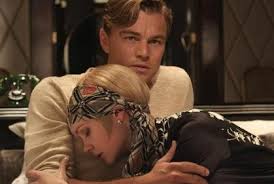
Then there is Leonardo Dicaprio…I mean, surely – what
a dynamite choice! We have the perfect echoes of Lurhman’s Romeo+Juliet, a memory of the younger Dicaprio and the canonicised greatest romance of all time (the
play…not his film!) becomes an intertextual memory comparable to his
pathological inability to forget the love he had for Daisy. Also, in having
Dicaprio, looking (as somebody, cant said remember who...) for the first time,
like a more mature man, has a fantastic resonance with the story’s pre-occupation
with time. His performance, with its unavoidable echoes of Rome+Juliet, also helps open up the film to an interesting critique
of ageing in Hollywood. The scene in which Gatsby has been shot – falling into
the pool, is shot from beneath, in a way which recalls the opening scene of Sunset Boulevard…a film all about faded
glamour, of not being able to live the
past. The connotations of a Hollywood allegory, extends the tragic Gatsby
to become a frighteningly confected dream figure for an America that is at once
entirely mythical and unreal, while being inescapably and destructively
present.
There were of course moments I wouldn’t feverishly
applaud: the writing appearing on the screen, in fragments of Fitzgerald’s text
just seems a tad too hammy…bordering on PowerPoint animation; Toby Maguire, if
one was kind could perhaps offer an interesting addition to the
Hollywood/fame/career context…but he does look distractingly like someone who
has been told, just before a shot, two conflicting emotions with which to
deliver his lines…either that, or someone has just whispered a mildly
entertaining but quite confusing joke into his ear before the take…leading his
performance to feel always slightly detached and undecided, as if he is
constantly on the verge of a sneeze or about to break character. That aside, I
thought the film was a hugely enjoyable and unfairly under-appreciated beast. 8/10
The Angel’s Share – Ken Loach – After avoiding prison,
‘Robbie ‘(Paul Brannigan) plays a Dad-to be assigned community service – John
Henshaw plays ‘Harry’ the community service officer (definitely not the right
term, but the bloke in charge) who shows an inspiring faith in the motley band
of ex-criminals…and ends up taking them on a tour of a whisky distillery. Loach
fuses moments of comic observation and well-written dialogue (all in often
hard-to-discern Glaswegian accents), with moments of gritty drama and social
realism. 7/10


Dog Star Man – Prelude – Stan Brackhage – perhaps one of the most
famous avant-garde American filmmakers, alongside Kenneth Anger and Maya Deren,
Brakhage pioneered a visceral and disjunctive visual experimentation, using
rapid, syncopated frames – fast cutting with kaleidoscopic rhythms, a sense of
collage and abstract disorientation. Flashes of colour, some with their origin
in physical marks on the celluloid (Brakhage would often paint directly on to
the film), others melting and blurring, strobing or bleeding with almost
recognisable images – a glimpse of flesh, of hair, or of windows, a snatched
instance of landscape, a passing moment… At times it seems like a chaotic
display of synapses, at other times, a beautifully disjointed life dreamt and
recalled in the moment before death. It is completely silent, foregrounding
visuals as the chosen or ‘purified’ (to draw on the avant garde tradition of
formal innovation) medium. An amazing and inspiringly immersive film (it is in
parts: Prelude, I,II,III,IV) – I’ve
only seen it through once…and did so while listening to trippy music…as this
definitely enhances the viewing…something electronic or ambient usually works
beautifully…and then you can have multiple viewings with variant soundtracks!
And thus I reveal a shameful insight into the thrill-seeking nature of my
recreational pastimes.